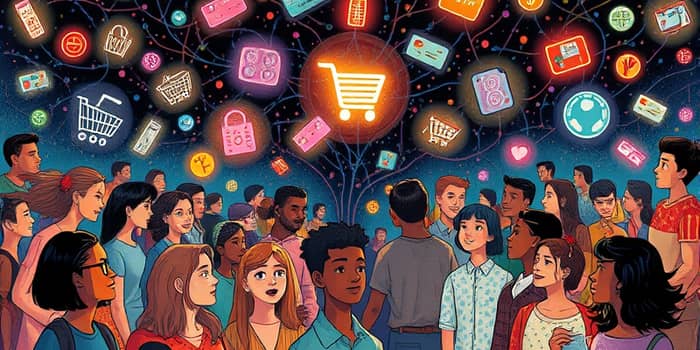
Every dollar we spend carries a hidden story. From the moment we swipe a card to the receipt we fold into our wallet, psychological forces guide our choices. This article unveils those forces to empower smarter spending.
The Driving Forces Behind Our Spending Habits
Our emotional state—from stress to celebration—can steer us toward or away from purchases. Feelings of joy or anxiety often prompt us to seek comfort or reward through buying.
At the same time, cognitive biases warp our perception of value. We anchor on original prices, mentally compartmentalize funds, and dread losses more than we cherish gains.
How Digital Payments Fuel Impulse Buying
Enter reduced pain of paying. Digital wallets and one-click checkouts make money feel intangible, distancing us from the reality of spending. This construct, termed “Spendception,” explains why we click “buy” more impulsively.
A recent Spendception study of 1,162 respondents revealed striking links:
These numbers show how digital ease translates to more unplanned purchases, especially among women, who report stronger impulse reactions under Spendception’s influence.
Generational and Income-Based Patterns
High-income consumers have fueled recent spending growth, while low-income households grapple with elevated credit card debt post-pandemic. Gen Z and Millennials stand apart in their approaches.
Gen Z cut overall spending by 13% in early 2025 but embraced Buy Now, Pay Later options—64% tried BNPL, though 40% faced late fees. They hunt for deals—79% wait for sales—yet pay premium for meaningful experiences.
Millennials, entering peak earning years, allocate 61% of discretionary funds to experiences rather than possessions. Their pattern underscores a shift from material accumulation to memory creation.
Seasonal, Cyclical, and Cultural Influences
Spending surges around Black Friday and winter holidays, dips in Q1, then rebounds with summer travel. Saturdays consistently top retail sales charts.
Beyond seasons, cultural phenomena—viral products and social media trends—can spark sudden spending frenzies. Emotional storytelling in advertising, anchored in scarcity or urgency, further inflates purchase desire.
Psychological Mechanisms at Play
- Emotional triggers: happiness or stress prompt comfort purchases
- Cognitive biases: anchoring on original prices and mental accounting dilute objective value
- Social proof: seeing “bestseller” tags convinces us of quality
- Scarcity and urgency: limited-time offers activate loss aversion
Decoding Your Dollars: Practical Strategies
Understanding these forces equips you to reclaim control. Consider adopting mindful spending habits that align purchases with your values and goals.
- Create a simple budget: assign every dollar a purpose before you spend
- Use cash envelopes for discretionary categories to reintroduce the tangible cost of spending
- Implement a 24-hour rule: delay non-essential purchases to reduce impulse buys
- Leverage technology wisely: set alerts for account balances and spending thresholds
These tactics combat Spendception by reestablishing awareness of each outflow, restoring the natural friction between desire and decision.
Enhancing Financial Literacy and Confidence
Half of U.S. consumers expect to be better off financially in 2025, a sentiment fueled by strong labor markets and wage growth. Yet optimism alone isn’t enough—financial literacy bridges the gap between hope and reality.
Regularly review your spending patterns, track progress, and adjust your budget. Small shifts, like negotiating recurring bills or prioritizing debt repayment, compound over time.
Embracing a Balanced Money Mindset
Spending psychology isn’t about suppressing joy. It’s about aligning purchases with your dreams—whether that’s a stress-free vacation, financial freedom, or meaningful gifts for loved ones.
By decoding the hidden messages behind your purchases, you transform spending from an impulsive act to a deliberate choice. Each transaction becomes a statement of your values.
Conclusion: Mastering Your Spending Story
Your financial journey is a narrative you write with every dollar. Recognize the unseen forces—emotions, biases, social signals—that shape your habits. Use knowledge to craft spending patterns that serve your highest ambitions.
When you decode your dollars, you don’t just track expenses—you tell a purposeful story of wellbeing, creativity, and growth.
References
- https://pmc.ncbi.nlm.nih.gov/articles/PMC11939284/
- https://www.bostonfed.org/publications/current-policy-perspectives/2025/why-has-consumer-spending-remained-resilient.aspx
- https://www.mastercardservices.com/en/advisors/economic-consulting/insights/8-reasons-why-consumer-spending-patterns-change
- https://betterworld.mit.edu/spectrum/issues/winter-1999/the-psychology-of-spending/
- https://www.jpmorgan.com/insights/global-research/economy/consumer-spending
- https://www.apa.org/monitor/2021/06/feature-consumer-behavior
- https://www.mckinsey.com/industries/consumer-packaged-goods/our-insights/how-todays-consumers-are-spending-their-time-and-money
- https://www.stmarysbank.com/learn/tools---resources/blog/detail/the-psychology-of-spending-and-how-to-manage-it
- https://www.mintel.com/insights/consumer-research/the-impact-of-changing-consumer-spending-habits/
- https://bpspsychub.onlinelibrary.wiley.com/doi/10.1111/bjso.12602
- https://www.pwc.com/us/en/industries/consumer-markets/library/gen-z-consumer-trends.html
- https://www.deloitte.com/us/en/insights/industry/retail-distribution/consumer-behavior-trends-state-of-the-consumer-tracker.html
- https://www.gwi.com/blog/consumer-spending-trends
- https://www.morganstanley.com/insights/articles/us-consumer-spending-trends-2025
- https://www.bea.gov/resources/learning-center/what-to-know-consumer-spending
- https://academic.oup.com/jcr/article-abstract/49/5/697/6603733